

Yoda warmth — three-layer fix history
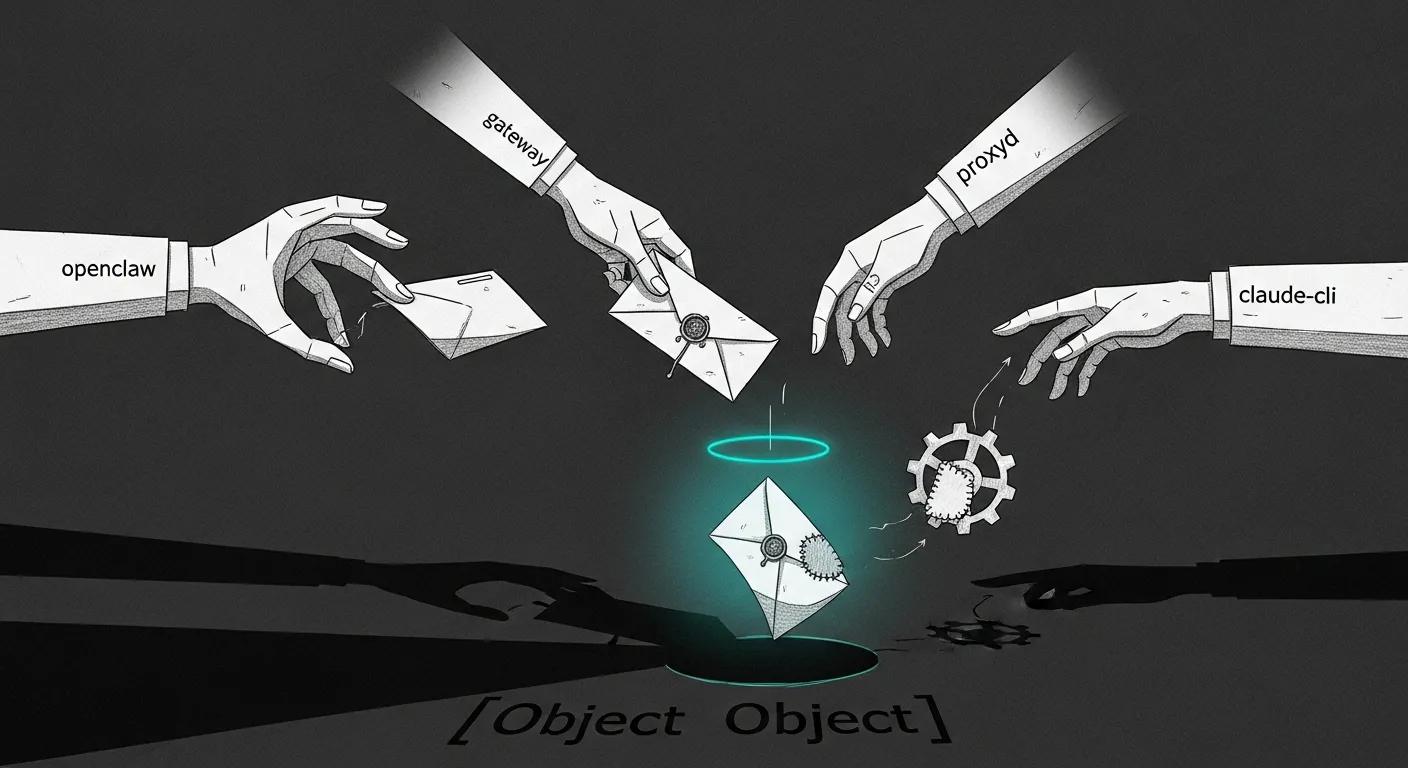
Bert texted Yoda good morning. Yoda replied that the message was
corrupted. It arrived, the model explained gently, as [object Object]
— what had Bert meant to send? The message was fine. Somewhere across
six hops between Signal and a Claude subprocess, a stray template
literal had rendered an operator’s words into JavaScript’s default noise,
and the model — ever helpful — described the noise back to him.
Yoda is the Haus assistant Bert texts on Signal at his fictional-block
demo number (real number redacted; pretend it is +15555550100). The
chain from operator to LLM and back is
openclaw, then a yoda-chat consumer, then the openclaw gateway, then
the council-tiered proxyd,
then claude-max-api-proxy, then the Claude CLI subprocess, then back
out through signal-cli. Six hops, three independent silent-failure
classes, one bug that masked another for ten hours. The fix needed
three layers, and we kept all three — because each one fails
differently.
The symptom
Section titled “The symptom”Every text Bert sent came back as one of three patterns, depending on which layer you were blaming that hour:
- Silence. The default openclaw harness emits
NO_REPLYfor any message that doesn’t need a tool call. Signal showed nothing back. - A canned acknowledgement. Once a wrapper trapped
NO_REPLYand substituted a warm canned text, the reply landed but felt scripted (ack,present,received). - The model insisting your message was corrupted. “Your message
came through as
[object Object]— what did you mean to send?” Even thoughfinalPromptTextin the JSON dump showed the operator text intact.
Three symptoms, three culprits, and for ten hours the loud one hid the real one. Here is the order we peeled them.
Layer 1 (retired) — patch openclaw’s silent-reply rewrite array
Section titled “Layer 1 (retired) — patch openclaw’s silent-reply rewrite array”openclaw 2026.5.24 shipped a silentReplyRewrite feature that
substituted a canned text for any agent reply of NO_REPLY. The
default canned texts were robotic (Standing by., Nothing to add right now.). The first attempt patched that dist file with warm
franglais entries.
This approach died when openclaw was pinned to 2026.5.20 — that
version doesn’t have the rewrite feature at all. The patch was
writing to a file that no longer existed. Lesson: editing a vendor’s
node_modules/<pkg>/dist/ works until the next pin or update rewrites
the path it lives at. Retired 2026-05-24 — the heal-yoda-warmth
recipe is gone from r2d2/recipes.yaml; the patch script lives at
~/.sanctum/scripts/yoda-warmth-patch.sh.retired-* for reference.
Layer 2 — a wrapper in our own repo
Section titled “Layer 2 — a wrapper in our own repo”If a vendor path can vanish under a pin, own the boundary yourself.
yoda_chat/agent.py (in our repo at
sanctum/yoda-chat/yoda_chat/agent.py) now owns delivery. It calls
openclaw with --json and no --deliver, parses the agent’s reply,
substitutes a warm canned text via warmth.pick_warm() if the reply
is NO_REPLY or empty, and sends the final text via the signal-cli
JSON-RPC send method itself.
The wrapper is version-agnostic — it only uses openclaw’s public
--json flag and signal-cli’s documented JSON-RPC API. Any openclaw
pin, bump, or downgrade leaves it intact. The R2D2 recipe
heal-yoda-warmth-wrapper redeploys warmth.py + agent.py from
the repo if the VM copy ever goes missing.
| Path | Purpose |
|---|---|
sanctum/yoda-chat/yoda_chat/warmth.py | WARM_TEXTS array + pick_warm(seed) deterministic picker + is_silent_reply(text) |
sanctum/yoda-chat/yoda_chat/agent.py | dispatch_signal_reply() — owns the openclaw call, the parse, the substitution, the signal-cli send |
sanctum/yoda-chat/tests/test_warmth.py | 7 unit tests — determinism, distribution, silent-reply detection |
This layer worked. But the reply still felt scripted, because it was —
Bert wanted real LLM-generated answers, not a warm shrug. The canned
path should be the Zeroth Rule floor, not the everyday case. Which is
how we finally admitted the NO_REPLY itself was the symptom, not the
disease. That led to Layer 3.
Layer 3 — the actual root cause
Section titled “Layer 3 — the actual root cause”Even with Layer 2 in place, every Yoda turn returned NO_REPLY from
openclaw, so the canned text fired every time. Direct openclaw calls
that bypassed Layer 2 still returned Your message came through as [object Object]. The bug had to be upstream of openclaw.
A sub-agent walked the request path one hop at a time and found it in
~/Library/pnpm/global/5/node_modules/claude-max-api-proxy/dist/adapter/openai-to-cli.js,
function messagesToPrompt(). The function used template literals on
msg.content directly. openclaw sends content in OpenAI multimodal
form — an array of {type:"text", text:"..."} blocks. JavaScript
stringifies an array of objects via the default toString() to the
literal [object Object]. The Claude CLI subprocess received that
string, and the LLM dutifully described the corruption it was handed.
The model was never confused. It was reading exactly what we sent it.
Fix: add a flattenContent() helper that returns the joined text
of the array blocks, then use it in all three role branches (system,
user, assistant). Marker // content-flatten patch v1 for
idempotence and R2D2 detection.
| Layer | Path | Trigger |
|---|---|---|
| Patch script | sanctum/scripts/patch-claude-max-proxy-content-flatten.sh | Manual / on-demand |
| Reapply LaunchAgent | sanctum/launchagents/com.sanctum.claude-max-proxy-content-flatten.plist | Daily 04:13 + RunAtLoad |
| R2D2 heal recipe | sanctum/scripts/r2d2/heal-claude-max-proxy-content-flatten.sh + recipes.yaml | Marker missing on R2D2 poll, 1h cooldown, severity high |
Verifying
Section titled “Verifying”Three independent probes, easiest first. The first two never touch Signal; the third sends a real text to the operator, so run it when Bert is expecting one.
# 1. Marker present in the proxy adapter?grep -c '// content-flatten patch v1' \  ~/Library/pnpm/global/5/node_modules/claude-max-api-proxy/dist/adapter/openai-to-cli.js# → 2
# 2. API probe at the proxy (skips openclaw + signal-cli)curl -s -X POST http://127.0.0.1:3456/v1/chat/completions \  -H "Content-Type: application/json" \  -d '{"model":"opus","messages":[{"role":"user","content":[{"type":"text","text":"what is 2+2?"}]}]}' \  | python3 -c 'import json,sys; print(json.load(sys.stdin)["choices"][0]["message"]["content"])'# → 4   (or similar; the proof is the absence of "[object Object]")
# 3. End-to-end honor probe (sends one real Signal message to operator)~/.sanctum/scripts/yoda-honor-probe.sh --timeout 120 --message "morning probe"# → PASS, delivered=True, was_warmed=False, text=<a real LLM reply>
What the wrapper is for, now
Section titled “What the wrapper is for, now”With Layer 3 in place, most operator texts get real LLM replies and the
wrapper’s pick_warm() rarely fires. That is the point: the wrapper is
the floor, not the room. When the LLM genuinely has nothing to say — no
tool grounded, no opinion — the Zeroth Rule (never silent to Bert)
still needs to emit something. LAST_RESORT_TEXTS is a 3-entry array,
sized to be the absolute minimum — three warm sentences that only exist
so that a good morning is never met with nothing at all. Everything
operator-facing rides the same doctrine: the
msg-bus can drop a hop, but
never a reply.
Related
Section titled “Related”- Yoda chat plumbing — the full six-hop chain this page debugs, hop by hop.
- Msg-bus shipped — the message bus that delivers operator-facing alerts via iMessage primary.
- Memory:
claude_max_proxy_object_object_2026_05_24.md(in the Claude_Code repo) — the post-mortem, including the four dead ends burned before the proxy-side fix landed.