

The fifth guardian
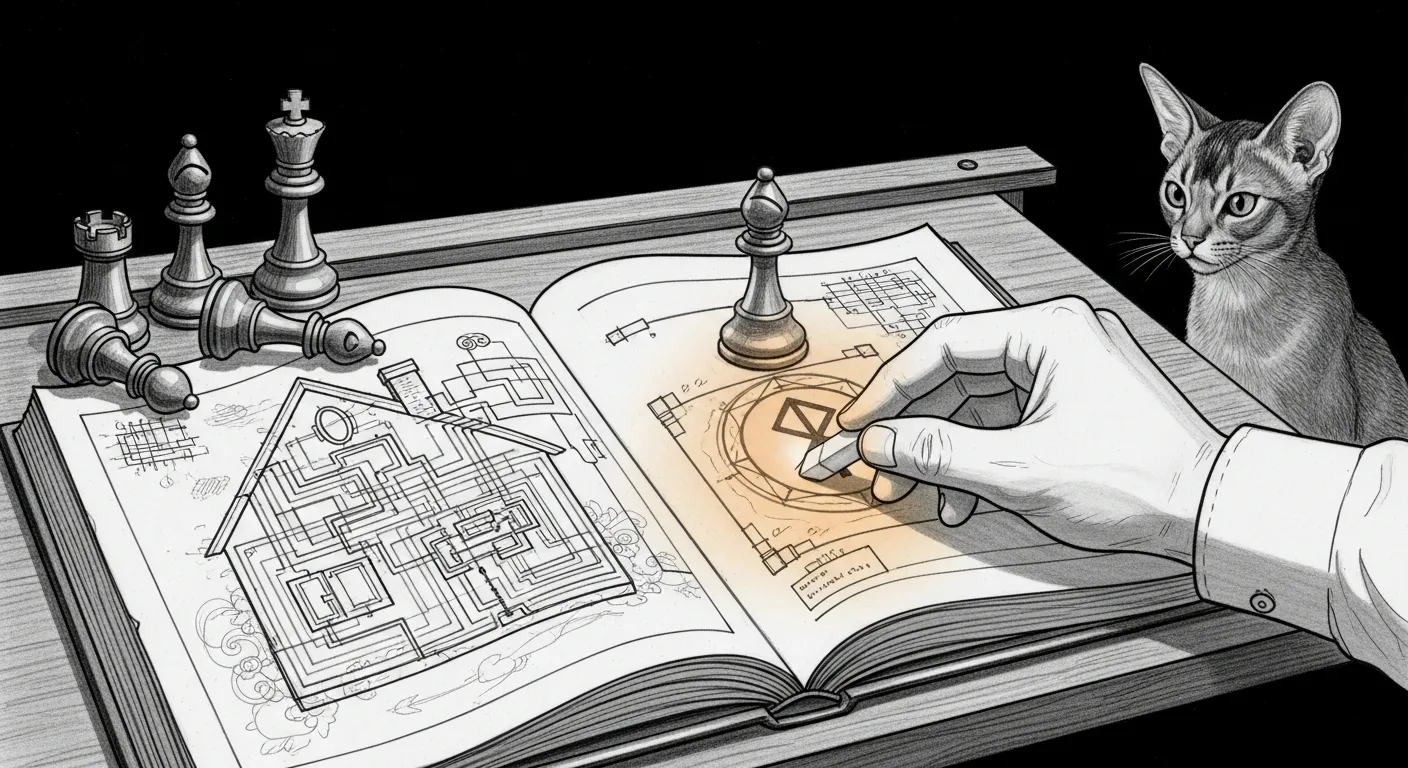
The twin that would not die took four guardians down with it. Restart policy, registry remediation, ha-self-healer, service-doctor’s --fix mode — all four, gone. The decommission note closed with a rule: enumerate everything with authority to restart it. For a day, the enumeration looked complete. Then a routine checkup asked an idle question. The answer was a fifth hand nobody had counted — and, from the corner of the table, an Abyssinian who had seen this coming.
The map still held the spell
Section titled “The map still held the spell”The runtime service layer renders from catalog truth: instance.yaml plus runtime_catalog.yaml, through one renderer, into forty-four manifests the watchdog lives by. The decommission had done the right thing at the manifest. The live home-assistant.yaml was hand-edited to point its probes at the Green (10.0.0.3), zero its restart budget, and carry a note saying exactly why. But rendered files are outputs, not sources. The catalog override for home_assistant still read the way it had for months: probe localhost, and when it fails, cd ~/.openclaw/homeassistant && docker compose up -d homeassistant.
render --check said DIFF home-assistant.yaml. It meant something exact. The next write-mode render — one routine sanctumctl render — would overwrite the safe manifest with the old one and hand the watchdog the twin’s defibrillator back. The hand-edit wasn’t a fix. It was a loan against the render. And the render always collects.
Porting the truth into the catalog needed the renderer to say three things we hadn’t taught it. actions: [] now means alert-only — emit the empty list and suppress the auto-generated heal fallback, for the services we never want it to touch. metadata_note: carries the do-not-resurrect warning into the rendered manifest. And ip_allow: teaches the renderer to append the inline # ip-allow: justifications the endpoint-resolution lint demands — yaml.safe_dump cannot write a comment, and a bare 10.0.0.3 in a rendered file is indistinguishable from drift. The pre-commit hook proved the lint was no formality. It blocked the fix itself twice, until every literal carried its reason.
The daemons the audit could not see
Section titled “The daemons the audit could not see”The same checkup flagged three manifests referencing launchd plists that “did not exist”: com.sanctum.firewalla, com.sanctum.server-mlx, com.sanctum.watchdog-rust. One was a real rename. The MLX seat’s label is com.sanctum.mlx now, and its manifest still probed for a python launcher (sanctum-server-dynamic) that no running process matches. The health check literally could not see the server it guarded.
The other two existed all along. The bridge and the watchdog run as system LaunchDaemons in /Library/LaunchDaemons, and the audit only globbed ~/Library/LaunchAgents. launchctl list from a user session cannot see the system domain either. Both daemons carry KeepAlive. launchd itself is their restart mechanism, and no passwordless launchctl exists for the system domain, so their manifests’ heal commands pointed at user-agent plists that were never there. Both are alert-only now — and the watchdog doubly so, since sanctumd is the remediation engine and cannot restart itself.
One label for the road. The file is watchdog-rust.plist, but the label loaded inside it is com.sanctum.watchdog. The filename lies.
The doctor fainted before every diagnosis
Section titled “The doctor fainted before every diagnosis”None of this had paged anyone. The instrument that would have reported it was broken in the quietest way possible. sanctumctl doctor crashed on an AttributeError — a bare Namespace() handed to verify(), which reads args.dry_run — after the render checks but before the verify suites ever ran. Every doctor run for who knows how long had died between the X-ray and the bloodwork.
Fixing the one-liner unmasked three failures that predated the sweep and had simply never been seen. The port-uniqueness test counted disabled services, so command_center (enabled: false since the dashboard merge, both nominally :3002) read as a conflict. Disabled services reserve no port now, matching the renderer that skips them.
The immune-system harness had fallen behind the temple-era watchdog binary three separate ways. First, the living-force temple probe wants mTLS certs no sandbox has (LIVING_FORCE_COUNCIL_ENABLED=false). Second, the Healing posture that follows a successful heal drops the per-service restart budget to max − 2; at the default of three that left budget one, already spent, so the failed-remediation path was budget-blocked before it could fail (WATCHDOG_MAX_RESTARTS_PER_HOUR=10 in the harness). Third, checks_run increments before the snapshot is stored, so gating on the counter and reading /health is a race the harness now polls through.
What remains
Section titled “What remains”The catalog now says what the haus means. The Green is the only Home Assistant, the manifest carries its own warning, and a write-mode render reproduces the safe state byte for byte — proven, since we ended the sweep with exactly that render. The audit sees both launchd domains. The doctor finishes: exit 0, 89 + 31 + 39 checks, zero failures, and the immune harness proves both the self-heal and the failed-remediation paths again, 10 for 10.
The twin still rests. The book that knew how to wake it has forgotten the spell, and the physician who would have noticed is back on rounds. Four guardians hold the line; the fifth is the one that remembers what the other four are for.