

2026-07-05: No Haus Is An Island
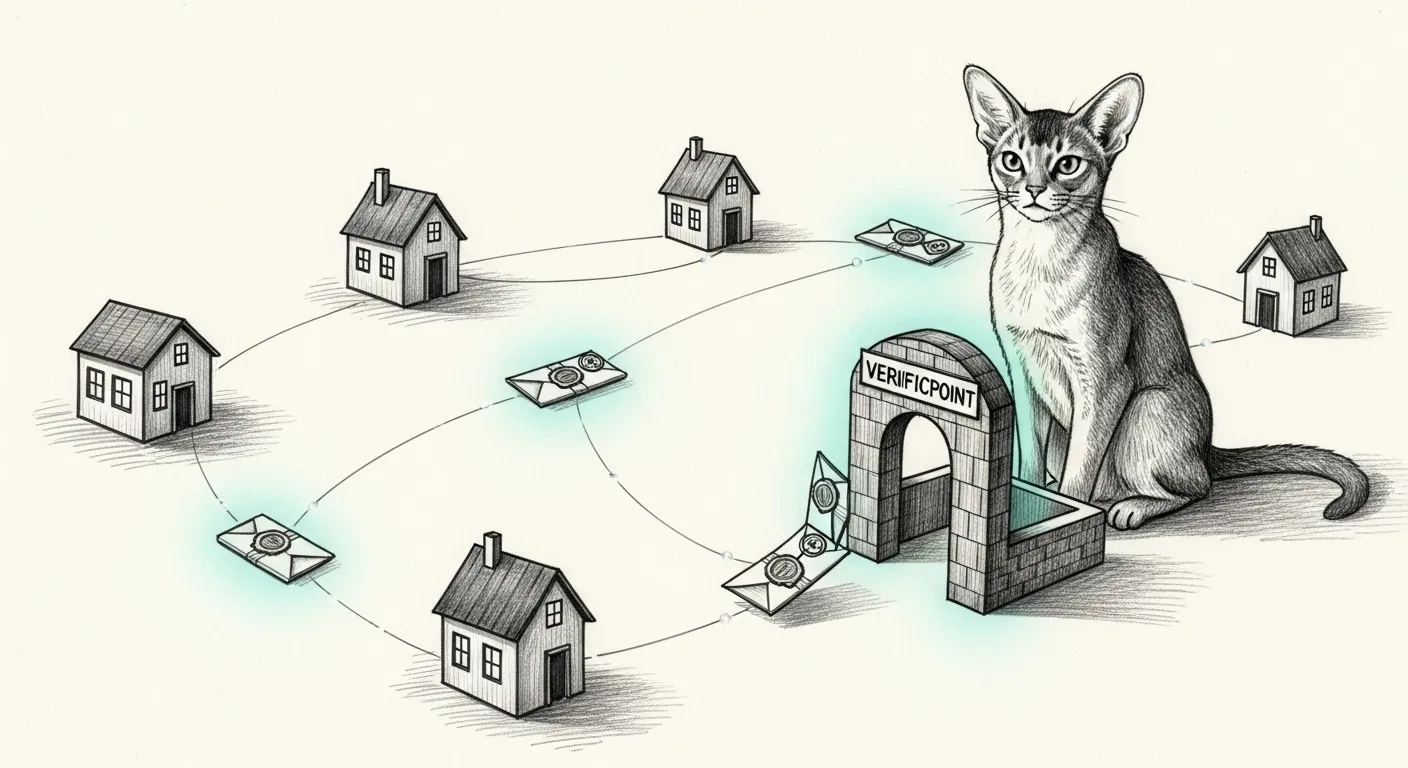
Every haus in the Sanctum world trains its own council champion. Every night, a little further up the hill: a fresh LoRA adapter, a tiered eval, a new best. It works. It also means every haus is an island — re-deriving from scratch what the haus next door already discovered at 3 a.m. last Tuesday.
The mesh is the bridge. Not a private tunnel between two machines Bert trusts — an open swarm, BitTorrent for council champions. Anyone can join. Anyone can seed. And that sentence should make your security instincts flinch, because the first thing an open swarm hands you is a stranger’s model weights and a friendly suggestion that you run them.
So the whole design is one question answered five times: how do you adopt a peer’s champion without trusting the peer?
The gauntlet
Section titled “The gauntlet”A champion arriving from the mesh is untrusted code and untrusted weights until it clears a fixed pipeline, and the pipeline short-circuits on the first failure:
- Hash. The bytes must reproduce the content hash they were advertised under. A champion is its sha256 — a sorted-file merkle over the adapter, so the id is the artifact and a single flipped bit is a different champion.
- Signature. The manifest must be signed by its producer’s mesh identity. Today that’s Ed25519; the seam is built for ML-DSA-65, the post-quantum signature the rest of the Sanctum PKI is migrating to, and it drops in behind the same three-method interface the day the binding is pinned.
- Eval. The champion must not regress yours. The peer’s self-reported scores are decoration — your haus re-runs its own tiered eval on the actual adapter and compares to your baseline. A champion that loses to the one you already have is politely declined.
- Sandbox. The adapter is loaded in an air-gapped VM under
unshare -n— no network namespace, nowhere to phone home — probed with a couple of prompts, and watched for any egress attempt. A model that tries to reach the network in a room with no doors gets its producer flagged. - Promote. Only now, with every prior gate green, does the new champion replace the local one.
The invariant that makes it safe to leave running: your champion is authoritative and is never replaced on a failure. Every rejection keeps what you had. The mesh is strictly additive — the worst a hostile peer can do is waste a few CPU-seconds of your eval and get remembered as hostile.
What’s proven, and what isn’t
Section titled “What’s proven, and what isn’t”Here is where a lesser field note would tell you the mesh is live and move on. It isn’t, and the honest shape matters.
The single-box drill is real and it passes: a genuine loopback tracker over HTTP, a real Ed25519 identity minting and signing, real content-addressing, and the full adopt pipeline — the happy path promoting a good champion, and all four gates rejecting the bad ones (tampered bytes → hash; forged signature → signature; a regression → eval; an egress attempt → sandbox). Eight for eight, exactly one promotion, the local champion held on every reject.
Two things in that drill are honestly bounded, and they’re bounded because they lean on infrastructure a single box can’t stand up:
- the eval runner is a fixed stand-in — the real gate logic runs, but the full 109-case eval on a 35B model is the nightly’s job, not the drill’s;
- the sandbox probe is a VM-pending stub on the happy path, because the real
unshare -negress check wants the air-gapped VM up.
Which is the whole point of shipping the sandbox as a real, fail-closed seam instead of faking it green: a VM that’s down, a probe that can’t render a verdict, a missing helper — all of it raises and rejects. A security gate you can’t run is a security gate that says no. The one thing it never does is shrug and wave an unvetted model through.
The gate that turns “single-box proven” into “field-proven” needs a second haus: box B seeds a champion, box A pulls it across its own tailnet, and the VM sandbox loads a genuinely foreign adapter and confirms it stays silent before promoting. That’s the acceptance test, and it’s written down, and it’s waiting for a second island to exist.
The join
Section titled “The join”None of this asks anything of a new haus but one command. sanctum mesh join
brings up Tailscale-on-box (its own free tailnet — the mesh is the shared
discovery layer on top, so nobody hits a free-tier ceiling), mints the mesh
identity if it’s absent, and registers with discovery. Every checkmark it prints
is earned from a real outcome: joined means the tailnet was observed up and
the tracker actually acknowledged you — never assumed. It’s also a skippable
chapter in sanctum onboard, because the first thing you should be able to do
with a swarm is decline to be in it.
Swarm Macro Analytics
Section titled “Swarm Macro Analytics”A decentralized mesh needs collective visibility without surrendering peer privacy. When a node registers or syncs, it emits an anonymized macro pulse:
- Country of origin: Two-letter ISO code derived from the host system locale (e.g.
CA,US,FR) without exposing physical location or IP. - Compute fleet profile: Apple Silicon family (
M4 Pro,M3 Max) and RAM tier (64GB,32GB) so the swarm understands aggregate model capacity. - Autonomy & Privacy index: The local vs. cloud inference ratio (% offline) and the local eval baseline.
Any peer runs sanctum mesh analytics to read the aggregated swarm state: active node count by nation, fleet compute power, mean offline autonomy, and the catalog’s peak benchmark score.
Tommy has seen a lot of parcels cross a lot of thresholds. He has never once let one through on the strength of its return address.