

The Castellan
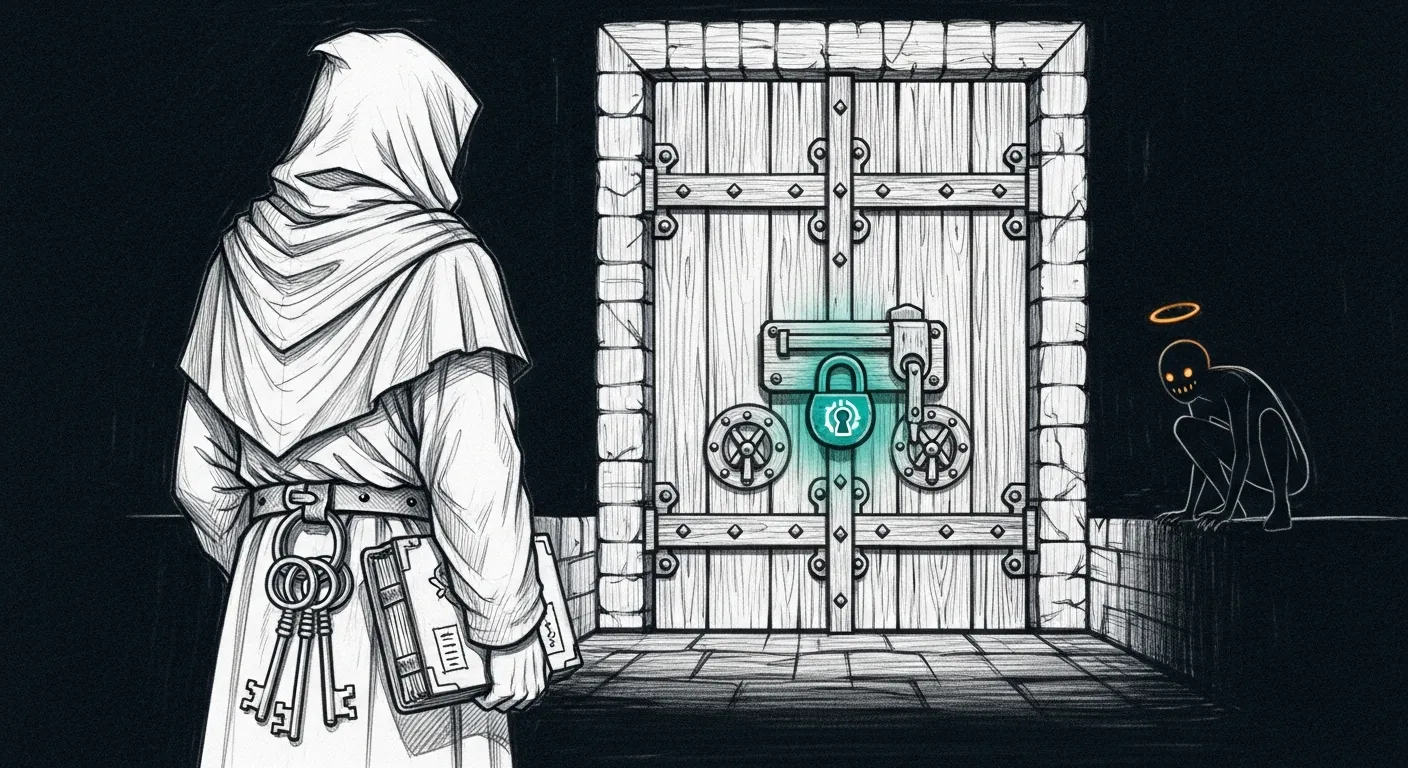
The Temple holds the kyber. The Council reaches for it through seven Jedi. But somebody has to keep the building — open its doors, ring its bell, and decide who eats first when the larder runs low. That officer is the Castellan.
His launchd label is haus.sanctum.castellan. His codename — used in the spec, the commits, and the lore — is Gollum, because he counts the precious memory all day and assigns it to its rightful keeper. The codename matters. Gollum the character is a warning about the precious: he had it, it consumed him, he could not put it down. The Castellan is the deliberate inversion. He has no authority his death can revoke and no information his death can lose. He was built so the precious cannot consume him.
Why the haus hired him
Section titled “Why the haus hired him”A 64 GB Mac Mini hosts the Temple’s kyber — Cilghal, the 35-billion-parameter MoE, 21 GB resident at idle and 41 GB at peak under a full 32K-token context. It also hosts an on-call code seat — Devstral Small 2 24B, 13 GB when she’s serving and effectively zero when she’s idle. Plus a Lima VM and the apps the operator actually uses. The arithmetic doesn’t work unless somebody keeps watch.
For four months that watch was a trio — sanctum-admit, sanctum-pressure-valve, and ram-sentinel. They all measured the wrong metric. RSS reported Cilghal as 45 megabytes. They argued with each other. The pressure-valve shed; the admit-controller admitted; the sentinel restarted a desktop app because it had the highest RSS in the table. None of them could see what was actually using the box.
The Castellan was hired to replace all three with one keeper who measures the real thing.
The metric the kernel actually uses
Section titled “The metric the kernel actually uses”macOS exposes the truth through libproc.proc_pid_rusage(RUSAGE_INFO_V6).ri_phys_footprint — the same number jetsam itself consults when it decides what to terminate. RSS is a lie for any process whose memory lives in GPU or wired pages, which is to say every MLX process. The Castellan reads phys_footprint once every two seconds and on every memory-pressure event the kernel signals through libdispatch.
| Process | RSS | phys_footprint |
|---|---|---|
| Cilghal (sanctum-mlx, 35B-A3B-4bit) | 45 MB | 21 GB current, 41 GB lifetime peak |
| Devstral (sanctum-mlx-devstral, 24B-4bit) | 17 MB | 13 GB current |
| Lima VM (sanctum-vm) | 2.4 GB | 2.4 GB |
What he does — and what he does not
Section titled “What he does — and what he does not”He does NOT arbitrate memory. The kernel already has an arbiter — compression plus jetsam priority bands plus wired pages — and it is correct, efficient, and impossible to outperform from user space. The Castellan’s job is to program the kernel’s arbiter: tell it which processes are critical, which are evictable, and which pages to pin. Once that policy is set, the OOM decision lives in the kernel and stays there.
He runs as a root LaunchDaemon — /Library/LaunchDaemons/haus.sanctum.castellan.plist, executing a root-owned copy at /usr/local/libexec/sanctum/castellan — because programmatic cross-process jetsam adjustment is a privileged operation on macOS. From that vantage he uses two kernel-mediated levers:
memorystatus_controlsets per-PID jetsam priority bands. Cilghal goes toCRITICAL(190); Devstral toIDLE(band 0, first to die); the Lima VM toHOME; the Castellan himself toCRITICALso the keeper of the Temple cannot be the first thing the kernel kills.metal-wired-limit-mbat each seat’s launch — Cilghal’s 18 GB of weights are wired and unswappable; Devstral’s 2 GB are wired with the rest pageable, so her pages yield first under pressure.
Each seat’s plist also carries a JetsamPriority integer — Cilghal 190, Devstral 0 — so the band is correct from the moment launchd spawns the process, before the Castellan’s first loop tick. The active loop re-asserts it every two seconds; the plist value is the birth floor.
He then runs a quiet two-second loop: re-measure, consider idle-bootouts of the on-call seat, write a heartbeat that another small process will read in a moment.
The three doctrines
Section titled “The three doctrines”- Kernel-as-arbiter. He never decides who dies. The kernel does. He only configures policy. The active loop does only what the kernel cannot do declaratively — load, unload, and refuse.
- Typical, not worst case. He plans each seat at what it typically holds while serving, measured — not at its peak (Bert’s call, 2026-10-03). Transients belong to the safety floor and to macOS compression; what he watches live is the kernel’s own available figure, swap depth and pressure. A request that does not fit queues, falls through to a cloud upstream, or refuses — it never evicts the brain.
- Deadman-timed everything. Every SIGSTOP he sends gets a tombstone file under
/Library/Application Support/Sanctum/Castellan/run/stopped/named for the PID. A companion process —castellan-deadman, a separate root LaunchDaemon — watches his heartbeat at/Library/Application Support/Sanctum/Castellan/run/heartbeat. If the heartbeat goes stale for more than sixty seconds, the companion SIGCONTs every process the Castellan left stopped and clears the tombstones.
When the Castellan dies
Section titled “When the Castellan dies”The protection lives in kernel state, not in his RAM. Jetsam bands set by memorystatus_control persist until reboot or explicit change. Wired Metal limits persist until the seat process exits. If the Castellan crashes, gets killed, or wedges, the bands hold, the wired pages hold, jetsam continues to shelter Cilghal and shed Devstral correctly without him. launchd restarts him on KeepAlive and he rebuilds his view from phys_footprint on boot. He carries no state worth saving.
Two hard rules make this real. First, the Cathedral’s critical path never goes through him — Cilghal does not call him, proxyd’s council-mlx route does not call him, and only the optional council-code ensure-loaded hook does, and on a non-200 it falls through to the next upstream rather than wedging the request. Second, every SIGSTOP is deadman-timed: a stopped process the Castellan never SIGCONTs is undone within ninety seconds — by the companion — without him.
This is what “military-grade fail-OPEN” means in this haus.
What he replaced
Section titled “What he replaced”| Retired daemon | Metric it watched | Where it failed |
|---|---|---|
sanctum-admit (port 2189) | RSS plus static capacity budget | RSS-blind to Metal pages — could not see the models it was supposed to gate |
sanctum-pressure-valve | swap usage | reacted only after swap began — too late to prevent pressure |
ram-sentinel | top-RSS offender | restarted the wrong process — a desktop app instead of the model actually consuming Metal |
The Castellan inherits port 2189 with a drop-in API surface — /status, /services, /load/{svc}, /release/{svc} — plus the new /ensure-loaded/{svc} endpoint the proxyd code-seat hook calls. That endpoint is the on-call lifecycle. If the seat is already in the live snapshot it’s a 200 instantly and a tick on the idle clock so the seat won’t be auto-evicted while traffic is active. If not, the Castellan gates the call through admission — the seat’s typical budget has to fit what the kernel says is available above the safety floor — and on Admit synchronously launchctl bootstraps the seat’s plist on a blocking thread, then polls probe_cmd to readiness so proxyd can forward the moment the response returns. On NeedsShedding it’s a 503 and the request falls through to the next upstream; the request path never wedges. The trio’s user-domain plists are renamed .retired-YYYYMMDD by the cutover script; backups live under ~/.sanctum/backups/castellan-cutover-YYYYMMDD-HHMMSS/. Rollback is a sudo launchctl bootout of the system pair, a manual rename of the trio’s .retired-YYYYMMDD files, and three launchctl bootstrap calls back into the user domain.
How he ships, and how he heals
Section titled “How he ships, and how he heals”A binary reaches /usr/local/libexec/sanctum/castellan only through ~/.sanctum/scripts/deploy-castellan.sh: clean, pushed source; his own tests; an atomic swap that keeps the previous binary; and a restart that is verified, not assumed — a pid that started after the install, and an answer on /status. The verification is there because on 2026-10-05 macOS killed his first launch on a fresh build and launchd threatened to drop the job. The script records what it installed in ~/.sanctum/bin/castellan.manifest.json, and ~/.sanctum/bin/castellan is a shim to the deployed binary, so the CLI and the daemon are one build.
His rescue of a pinned seat kickstarts a job launchd still has and bootstraps one it has lost; kickstart alone cannot bring back a vanished job. haus.sanctum.heal-canary keeps him honest: the Castellan Heal Drill boots it out and expects him to put it back within seconds. He did it in about one — the field note has the night.
Since that night his log is silent at Normal, so castellan-canary (the sentinel that pages if he dies, crash-loops or hangs) no longer reads silence as a hang. It judges his main loop by its own outputs — the deadman heartbeat every five seconds, the pinned probe every two — and calls him wedged only when all of them stop. It learned that from one false CRITICAL on 2026-10-06.
Where to read the wiring
Section titled “Where to read the wiring”The design spec lives in the operator’s workspace at docs/superpowers/specs/2026-05-29-gollum-memory-manager-design.md and the implementation plan in docs/superpowers/plans/2026-05-29-gollum-memory-manager.md — twenty-eight TDD tasks across thirteen phases, brainstormed via the Council and built behind a fresh subagent per task with two-stage review. The crate is services/sanctum-castellan/ in sanctum-rs.
He is quiet on green. When the Cathedral is alive, the Castellan is the reason. Codename: Gollum.