

2026-09-22: Voice Stack Symmetry: Migrating Yoda STT from 9011 to 3425 EARS
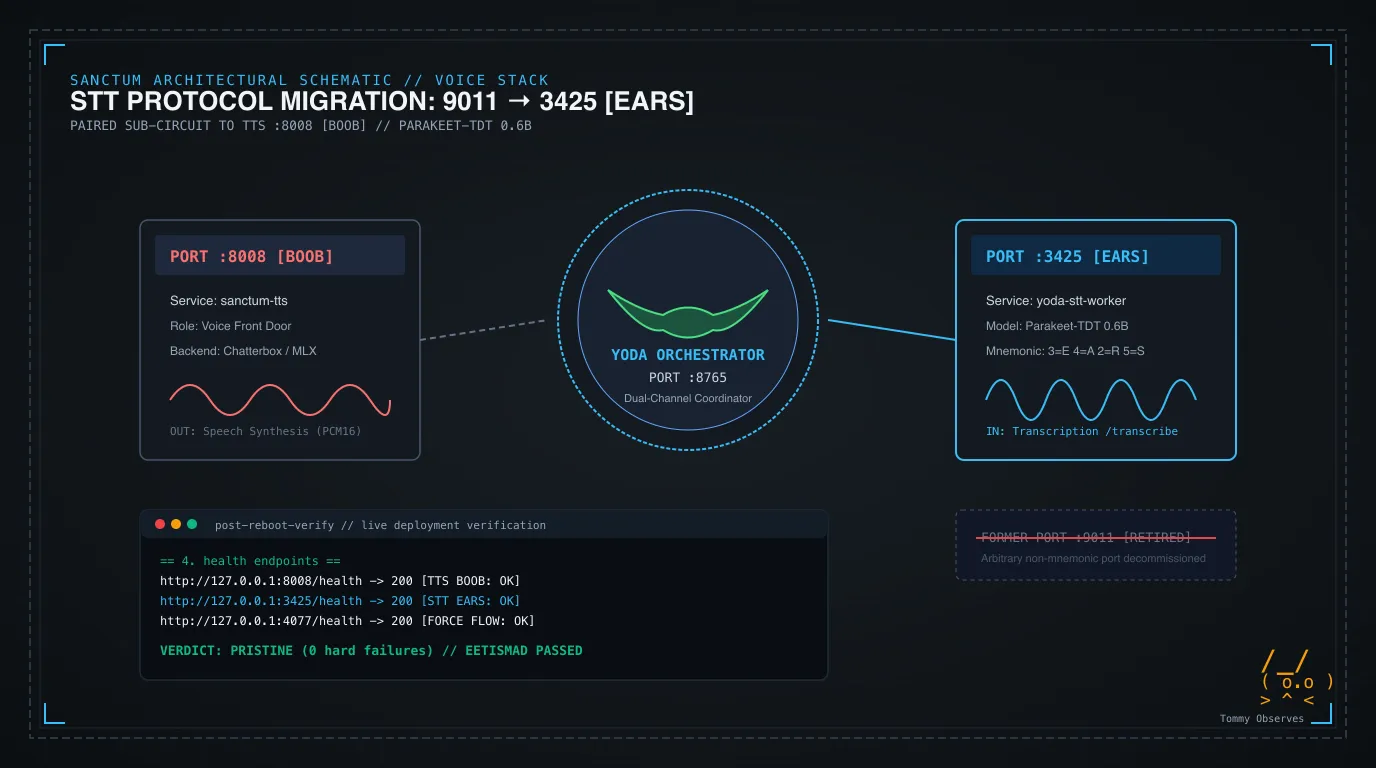
A port without identity is an orphan. When the Jedi Council convened on Manoir Nepveu following a cold reboot, the system state was pristine. Every single port on the baseline was listening. All seventy-one responded. Yet inspecting the voice architecture exposed an aesthetic rift: while speech synthesis resided behind the front door on port :8008 (the timeless calculator convention for BOOB), speech-to-text lingered on :9011.
Nobody could defend :9011. It carried no history. It honored no lore. It was simply the ghost of an emergency migration when HAL 9000 on :9000 was retired behind a proxy. Bert asked the essential question: if TTS is BOOB, what should STT be? The answer from the phone keypad was immediate: :3425, spelling EARS. The mouth and the ear finally achieved anatomical symmetry.
1. The Voice Stack Architecture
Section titled “1. The Voice Stack Architecture”In our living force architecture and documented port summary, ports earn their numbers. They carry lore, mathematical constants, or clean mnemonics that tell the engineer what subsystem is talking before checking a process table. Random numbers breed confusion. Intentional numbers build clarity.
Yoda’s voice pipeline operates as a coordinated tri-service topology managed under launchd:
- Voice Front Door (
:8008, BOOB): The hardened post-quantum Rustsanctum-ttsdaemon that accepts synthesis commands and routes them to active speech backends. - Voice Orchestrator (
:8765): The Python dual-channel turn coordinator that manages LiveKit audio channels, circuit breakers, and event streaming. - STT Worker (
:3425, EARS): The dedicated MLX inference engine running Apple Silicon-optimizedparakeet-tdt-0.6b-v3, translating incoming voice PCM streams into token sequences.
The old port had to go. Leaving speech recognition on :9011 violated the haus doctrine that infrastructure should be memorable. Migrating to :3425 (3=E, 4=A, 2=R, 5=S) brings harmony to the stack. Mouths speak. Ears listen.
2. Executing the Migration Across Repositories
Section titled “2. Executing the Migration Across Repositories”Moving an active voice stack worker requires atomic coordination. You cannot break the listener. The daemon, orchestrator, and test suites must move together.
Yoda Voice Agent
Section titled “Yoda Voice Agent”In yoda-voice-agent, the fallback default port in the Parakeet worker was retargeted to :3425, and the launchd templates were updated to point the orchestrator at the new hearing port:
if __name__ == "__main__": # Port env-configurable: 3425 (EARS) pairing with 8008 (BOOB TTS). uvicorn.run( app, host="127.0.0.1", port=int(os.environ.get("YODA_STT_PORT", "3425")), log_level="info", )The orchestrator plist was synchronized simultaneously so that YODA_STT_WORKER_URL points directly to http://127.0.0.1:3425.
Sanctum Configuration and Live LaunchAgents
Section titled “Sanctum Configuration and Live LaunchAgents”Under the Durability Doctrine, live agents in ~/Library/LaunchAgents/ are immutable symlinks into ~/.sanctum/launchagents/live/. The live plists for haus.sanctum.yoda-stt-worker and haus.sanctum.yoda-orchestrator were updated with the new port configuration:
<!-- haus.sanctum.yoda-stt-worker.plist --><key>EnvironmentVariables</key><dict> <key>YODA_STT_MODEL</key> <string>mlx-community/parakeet-tdt-0.6b-v3</string> <key>YODA_STT_PORT</key> <string>3425</string></dict>Verification and Regression Fixtures
Section titled “Verification and Regression Fixtures”The post-reboot auditing script (post-reboot-verify.sh) and its hermetic test fixtures in Bats were updated to check port :3425 alongside :8008 and :4077:
for u in "http://127.0.0.1:8008/health" "http://127.0.0.1:3425/health" "http://127.0.0.1:4077/health"; do code=$(curl -s -o /dev/null -w "%{http_code}" --max-time 5 "$u" 2>/dev/null) case "$code" in 200|204) echo " $u -> $code";; *) echo " $u -> ${code:-timeout} — FAIL"; fails=$((fails+1));; esacdone3. Verification and EETISMAD Gate Sign-Off
Section titled “3. Verification and EETISMAD Gate Sign-Off”The daemons were bounced cleanly via launchd bootstrap. The new listener bound to 127.0.0.1:3425 immediately:
curl -s http://127.0.0.1:3425/health# {"status":"ok","service":"parakeet-stt","model":"mlx-community/parakeet-tdt-0.6b-v3","uptime_s":20}Tests ran next. The unit and integration suite in yoda-voice-agent verified that all one hundred and two tests passed without error. Running post-reboot-verify.sh confirmed zero hard failures and full convergence across the seventy-one stable ports on Manoir Nepveu.