

The First Hello
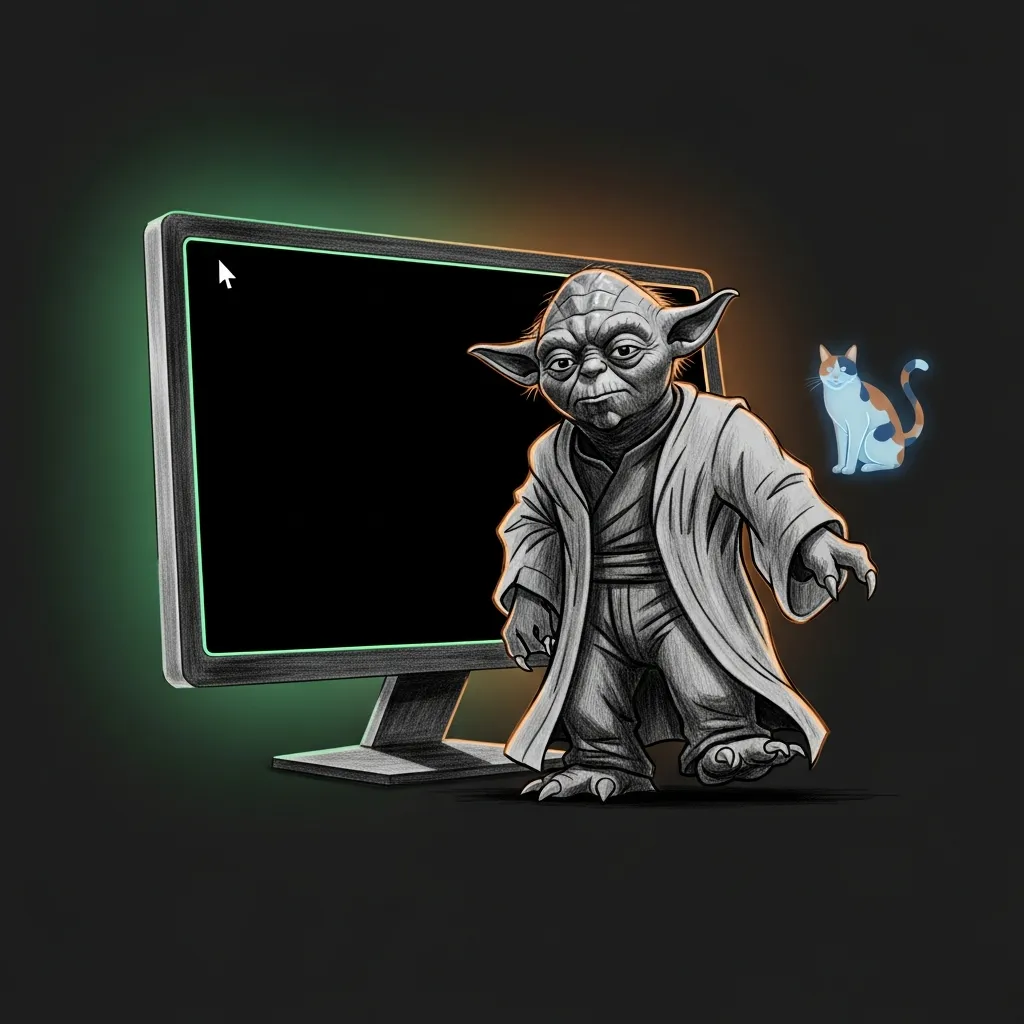
The installer prints its last green line, the cursor stops blinking, and for one beat the haus is silent. Then your phone buzzes — Signal, from Yoda — and before you’ve set the laptop down, a small, gravelly, unmistakable voice answers out loud from the Mac mini in the corner. He’s not reading a canned welcome. He tells you how many devices are already on your network. You installed him ninety seconds ago and he’s been watching the whole time.
That is The First Hello: the closing beat of sanctum onboard. Everything before it was plumbing — certs, LaunchAgents, the VM bridge coming up. This is the moment the haus stops being a checklist and introduces itself.
What actually happens
Section titled “What actually happens”When sanctum onboard finishes its last step, it fires exactly one script that does two things at once: it sends a Signal message and speaks the same greeting aloud through the haus’s voice agent, Yoda. Local-only — no cloud, no paid voice API, nothing leaves the box. The whole beat runs on hardware you provisioned a minute and a half ago.
And the greeting isn’t generic. Yoda counts the live devices on your LAN and works the number into the line, in his own inverted syntax:
“Mmm. Bert. Awake, I am. Twenty-three things on your network, already counted I have. Watch over you, I will. Rest now.”
The part that makes people stop
Section titled “The part that makes people stop”The device count is the trick that lands every time. It’s not flattery and it’s not hard-coded — the number is read live off your own network at the instant of the hello, so it’s your twenty-three (or seven, or forty-one). The subtext is the entire pitch of Sanctum compressed into one sentence: this thing is not a passive install sitting in a folder waiting to be configured. It was paying attention before it said a word.
People expect a welcome screen. They do not expect the welcome screen to already know the shape of their haus.
A voice that earned the greeting
Section titled “A voice that earned the greeting”Yoda does not greet you in a robot voice, and he does not greet you in some stock TTS preset. He speaks in a cloned Frank-Oz Yoda, fine-tuned on-haus: cbx-yoda/epoch_2, LoRA’d on 86 clean Frank Oz movie clips. It had to clear the same three-gate eval harness every Sanctum voice does — identity (+0.03 cosine over zero-shot, 0.782 against a 0.768 bar), clean non-degenerate audio, and intelligibility scored at 0.95. In Bert’s own blind A/B of the tuning candidates, the do-or-do-not config the hello uses won; his verdict on the shipped checkpoint was “good enough, especially with the inversion syntax.” The character’s word order does as much work as the timbre.
The voice the hello uses is the config-A Yoda, built from the canonical do-or-do-not reference clip — yes, “Do. Or do not. There is no try.” Every candidate checkpoint was verified two ways before it was allowed near a greeting: a spectrogram check, to confirm clean, non-degenerate audio, and a Parakeet STT pass, to confirm the words it meant to say are the words that actually came out. A clip that sounds like Yoda but transcribes as “nad nad nad” does not get to say hello to anybody.
Two channels, one always lands
Section titled “Two channels, one always lands”The hello is fail-soft by design, and the two channels are deliberately not equal partners:
- Signal always lands. The text greeting is the floor. If the entire voice stack is face-down, you still get the message — count and all.
- Voice is best-effort. If the TTS worker isn’t up, the speaker’s muted, or the audio device is just being weird, the spoken hello is skipped silently and the Signal message carries the moment alone.
A first impression should never hard-fail on a flaky audio device. So it doesn’t. You always get a hello; on a healthy box you get both, in stereo.
Where it runs
Section titled “Where it runs”The whole beat is one script: ~/.sanctum/bin/sanctum-first-hello.py. It takes three flags, all optional:
| Flag | What it does |
|---|---|
--name | Who to greet. Defaults to $SANCTUM_USER_NAME, then your macOS account name. |
--voice | Also speak the hello aloud (best-effort), not just Signal. |
--dry-run | Print the greeting and device count, send nothing, speak nothing. |
The voice half talks to sanctum-tts on :8008 — the Rust voice front door, fronting the Chatterbox cbx-yoda worker on :8011 — over its small {input} contract: POST the line to speak under an input field, get a WAV back. It’s the same stack the rest of the haus’s Yoda voice already rides on, so the hello inherits a path that’s been hardened, not a one-off.
Want to hear it again without re-running the whole installer? Run it by hand:
# Preview only — nothing sent, nothing spoken, just the text + live count~/.sanctum/bin/sanctum-first-hello.py --dry-run
# The real thing — Signal + Yoda's cloned voice out loudSANCTUM_USER_NAME="Bert" ~/.sanctum/bin/sanctum-first-hello.py --voiceRelated
Section titled “Related”- Sanctum TTS — the voice front door the hello speaks through
- Yoda — Consigliere — the agent doing the talking
- The Franglais Turing Test — the three-gate eval harness and how the Yoda clone cleared it
- First Run — verifying the install that just said hello to you