

R2D2 — Auto-Fix Supervisor
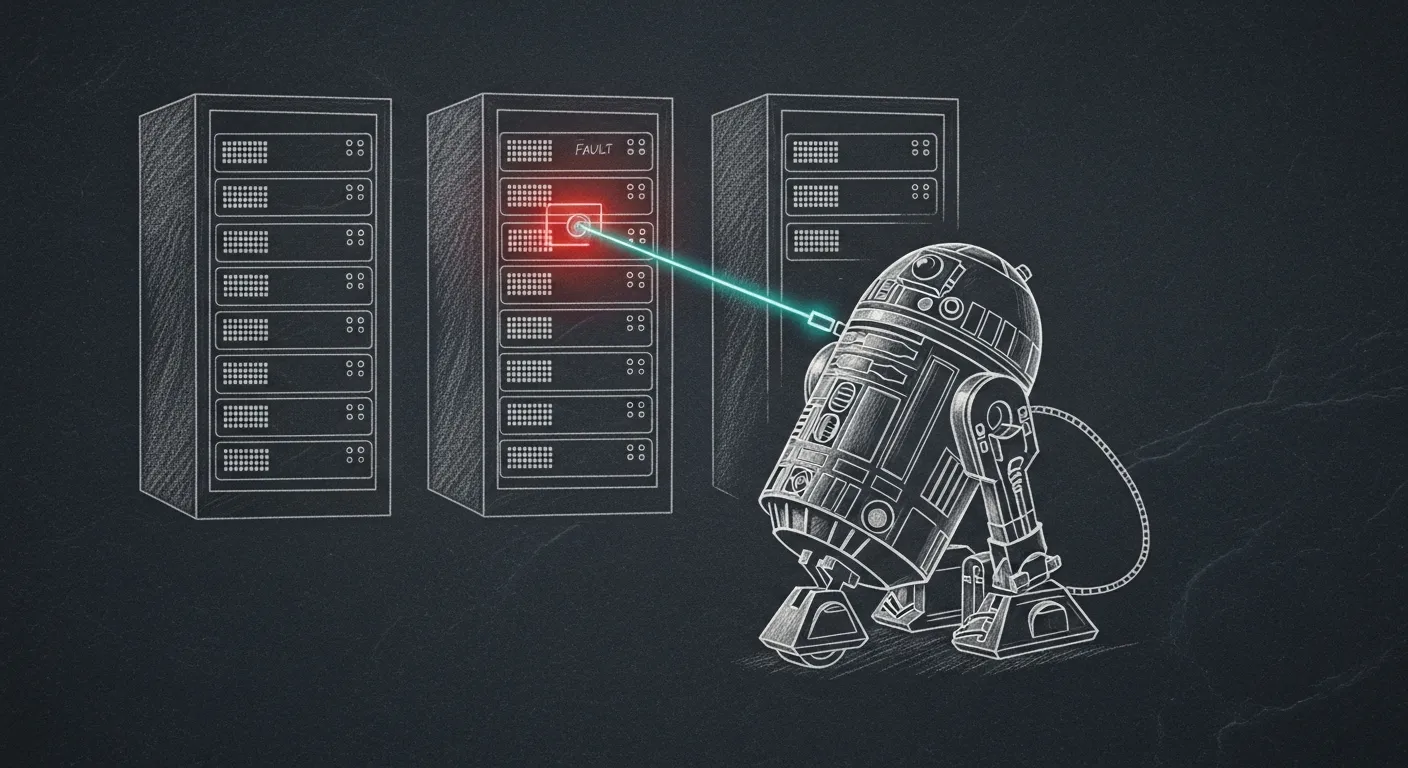
Some breakage announces itself. A gateway crashloops, the phone rings, an operator fixes it. The quiet kind is worse: a LaunchAgent respawning a dead VM for nineteen days while nobody happens to look. R2D2 is the droid for the quiet kind.
It sits between the four purpose-built autohealers (OpenRouter key rotation, mlx-drift bootout, SOPS sync, mgmt-key failover) — each solving exactly one problem — and the human escalation path down Force Flow. It is the generalized dispatcher for the long tail: anything novel-but-bounded an operator would otherwise repair by hand at 11pm.
The shape is deliberate: deterministic detectors + LLM-classified notices feed a small curated registry of named recipes; an eleven-layer safety stack guards every fire; the agent’s only mutation surface is a hard-allowlisted set of shell scripts under ~/.sanctum/scripts/r2d2/. The LLM never gets a shell — only a classification head and a recipe pointer.
Why R2D2 Exists
Section titled “Why R2D2 Exists”Three latent problems surfaced in a single day (2026-05-16), all catchable by a generalized auto-fix loop:
- A Colima LaunchAgent respawned a dead VM for 19 days after the OrbStack migration retired the workload, not the plist.
- A merged cathedral binary ran for 30 hours in production because no one ran
bootout/bootstrapafter the build. - The vault FTS5 index held 11 rows for 2,032 markdown files — auto-reindex was gated on
count == 0, never fired.
All three are detectable with one-line probes, safe to fix automatically, and invisible until someone happens to look — the case for a generalized dispatcher with a registry of named cures.
The Eleven-Layer Safety Stack
Section titled “The Eleven-Layer Safety Stack”Every detection — deterministic or Hermes — passes through the stack below, in order. Any layer can short-circuit to “audit-only” without firing the recipe.
| # | Layer | Mechanism |
|---|---|---|
| 1 | Kill-switch | Presence of ~/.sanctum/state/r2d2-disabled short-circuits every detection. Operator-facing emergency brake. |
| 2 | Allowlist | Scripts must resolve under ~/.sanctum/scripts/r2d2/. Path traversal is blocked even if recipes.yaml is tampered with. |
| 3 | Cooldown | Same target can’t re-fire the same recipe within its cooldown_hours (1h, 2h, 6h, 24h, or 168h, scaled to blast radius — weekly for orphan-plist retirement, hourly for a gateway crashloop). |
| 4 | Classifier-only | Legacy emergency brake at ~/.sanctum/state/r2d2-classifier-only. Off by default since v0.5. When present, every fire is audit-only. |
| 5 | Dry-run promotion | When dry_run_required: true, the first detection fires --dry-run and writes a promotion entry. The next detection within a 24h window fires for real. |
| 6 | Hermes extra-dry-run | LLM-classified detections always pass --dry-run regardless of recipe-level setting — the model is less trustworthy than a deterministic detector. |
| 7 | Recipe-id validation | If Hermes proposes a recipe_id not in the registry, the decision is coerced to escalate and the hallucination is audit-logged. |
| 8 | Cycle bookends | Each cycle emits cycle_start + cycle_end rows with a UUID and duration_s. Any 10-minute sweep is bisectable without ambiguity. |
| 9 | Chitti heartbeat | Cycle end POSTs to chitti’s samskara endpoint (127.0.0.1:2188/action) so peer agents see R2D2 alive: {service: r2d2, pattern: cycle, action: heartbeat, success, evidence}, where evidence carries cycle=<id> det=<n> fired=<n> hermes=<n> cost_usd=<n> dur=<n>s. |
| 10 | Proportional Force Flow escalation | detector_error, missing_detector, and decision=exec_error rows escalate to Force Flow — but at a severity that reflects what failed, so P0/P1 stays crucial, not R2D2’s own health. A config/code hiccup (missing detector, detector raised, contract violation) lands at warn; only a recipe heal that ran and FAILED on a high/critical recipe escalates at error/critical (the thing it guards may be down). A self-ingest guard also drops source=r2d2 lines from the Force Flow tail, so R2D2 never re-classifies its own escalations into a feedback loop. Silent failures are still prohibited — they’re just no longer all paged as P0. |
| 11 | Bounded audit log | ~/.sanctum/logs/r2d2-audit.jsonl rotates to .jsonl.1 above 50 MB. Unbounded resources are not bounded. |
The Recipe Registry
Section titled “The Recipe Registry”Nineteen recipes ship, each a four-tuple of (detector, script, dry-run policy, cooldown). Adding one more is a YAML entry plus a shell script — no code change, no privilege escalation surface. A representative slice:
| id | severity | Fires when | Action |
|---|---|---|---|
retire-orphan-launchagent | low | A com.sanctum.* plist’s Program path no longer exists on disk | launchctl bootout + rename plist to .retired-YYYY-MM-DD |
reload-service-after-merge | medium | A launchd-managed com.sanctum.* process started more than 60s before its on-disk binary’s mtime (merged + rebuilt, never reloaded) | bootout + bootstrap to pick up the new binary |
reindex-stale-fts | low | The memory-vault FTS5 index has fewer than 50% of the on-disk markdown file count | Move .vault.db aside with .stale-YYYY-MM-DD suffix; next consumer auto-reindexes |
repair-keychain-secret-drift | medium | A ~/.sanctum/secrets/<name> value differs from the matching macOS Keychain entry | security add-generic-password -U from the secrets file (old value captured to audit log first) |
heal-stale-firewalla-dnsmasq | medium | Force Flow reports a screen-group unblocked but Firewalla’s on-disk dnsmasq policy_*.conf still NXDOMAINs one of its MACs | Backup → delete redis policy:N + zrem policy_active + sudo rm policy_N.conf → SIGHUP dnsmasq → verify |
heal-openclaw-gateway-config-crashloop | high | openclaw-gateway is in a sustained crashloop (≥3 restarts in 5 min) due to a Zod schema validation failure on openclaw.json | Restore the most recent .bak-pre-* / .bak-broken-* backup, preserve the broken file, restart, assert active |
snapshot-openclaw-gateway-good | low | The gateway is active and stably up but no fresh openclaw.json.bak-good-* exists for the crashloop heal to roll back to | Snapshot the live config — but only when the gateway is stable and the on-disk mtime predates the gateway’s start, so a mid-migration edit can never be frozen as known-good; prune to the last 5 |
heal-sanctum-server-secret-leak | high | A sanctum-managed launchd plist has hardcoded provider secrets (sk-or-v1-, sk-ant-, AIzaSy, ghp_, xoxb-) in EnvironmentVariables | Backup plist, plutil -remove the offending env var (only if a ~/.sanctum/secrets/<name> counterpart exists), bootout + bootstrap, verify |
heal-sanctum-mlx-codestral-down | high | sanctum-mlx-codestral in a sustained crash-loop (3+ in 5 min) or its log shows repeated model-load / mTLS / Metal failures | Bootout codestral, preserve the broken plist (.failed + timestamp), bootstrap sanctum-mlx-coder as the Qui-Gon fallback; vault-announces critical. Written for the pre-Devstral coder seat — its target label no longer loads (the live coder service is com.sanctum.mlx-devstral-rust, Devstral on :3301), so this recipe sits dormant until it is rewritten for the new seat |
heal-claude-max-proxy-content-flatten | high | claude-max-api-proxy’s dist lost the content-flatten patch v1 marker (a pnpm update regression), so every Yoda reply becomes the literal “[object Object]“ | Re-run the idempotent patch script + restart com.sanctum.claude-max-proxy |
heal-claude-max-auth-refresh | high | claude auth status reports loggedIn: false — the Claude Max OAuth refresh token is dead (the real signal, not the keychain expiresAt, which drifts and false-alarms) | Exercise an authed call to refresh the access token + bounce the :3456 proxy; escalate the human-only claude auth login only if still dead |
heal-force-flow-bridge | high | Force Flow’s haus-control reconciler gets HTTP 401 from the Mac Firewalla bridge (127.0.0.1:1984) — a Lima VM shadowing the port, or token drift | Wrap force-flow-bridge-sentinel.py --force: add the lima 1984-ignore guard and drop the guest listener, or rewrite the canonical token from the live bridge |
reload-stuck-launchd-service | medium | The launchd-health-sentinel flags a com.sanctum/jocasta/openclaw KeepAlive service as actively crash-looping (running pid, alive under 10 min, non-zero exit) after its intentional-non-zero allowlist | launchctl kickstart -k the wedged service + verify a live pid or clean exit. Crash-loops only — never “stuck” timer jobs (they re-run on schedule); heavy/dedicated-healer services (mlx/codestral/gateway/claude-max) excluded |
reconcile-cosmetic-plist-drift | low | sanctum-plist classify <label> returns cosmetic-drift — the live prod plist differs from its repo copy but every changed line is provably cosmetic (a --tls-host marker, a Tailscale IP matching the live one, a JetsamPriority block) | sanctum-plist reconcile --yes --cosmetic-only captures prod back into the repo. Double-gated, fail-closed: a --model/--adapter-path edit classifies as drift and pages the human instead |
The registry is the safety surface. Hermes can never invent a new recipe at runtime — if a notice doesn’t match anything in the registry, it gets the escalate path.
Ingest Paths
Section titled “Ingest Paths” ┌──────────────┐ │ Cycle every │ │ 10 minutes │ └──────┬───────┘ │ ┌───────────┴───────────┐ ▼ ▼┌─────────────┐ ┌──────────────────┐│ Deterministic│ │ Force Flow log + ││ detectors │ │ chitti samskara ││ (one per │ │ tail past ││ recipe) │ │ bookmark │└──────┬──────┘ └────────┬─────────┘ │ │ │ ▼ │ ┌──────────────────┐ │ │ Hermes classify │ │ │ (LLM via OR) │ │ │ {auto|escalate| │ │ │ info} │ │ └────────┬─────────┘ │ │ └────────┬───────────┘ ▼ ┌──────────────┐ │ 11-layer │ │ safety stack │ └──────┬───────┘ │ ┌───────────┴───────────┐ ▼ ▼┌────────┐ ┌──────────┐│ Recipe │ │ Audit log││ script │ │ + chitti ││ fires │ │ + FF │└────────┘ └──────────┘- Path one — deterministic detectors. One Python function per recipe, returning
Detectiondataclasses. Cheap, exact, no model spend. - Path two — Hermes ingest. Tails Force Flow log and chitti samskara past a bookmark, classifies each new line with
nousresearch/hermes-3-llama-3.1-70bvia OpenRouter, returning{auto:<recipe-id>, escalate:<reason>, info}. Capped at 5/cycle × ~$0.0001 ≈ $0.07/day under full load.
Hermes is optional. Without R2D2_HERMES=1 in the plist, the LLM layer is skipped and only the deterministic detectors run.
The Vault Path (v0.4)
Section titled “The Vault Path (v0.4)”A third path reads the Memory Vault inbox — the cross-session, cross-agent message bus. It is R2D2’s lowest-trust input, gated hardest accordingly: roughly ten agents write it, from: is self-asserted, bodies are free text that can steer an LLM, and the corpus is dominated by status broadcasts (STONE 2 ROOT-FIXED) that read like action requests.
Eligibility is default-deny: a message is read only if it carries a priority: P0|P1|P2 field AND a to: addressed to r2d2. (priority: is new; do not conflate it with the existing importance: float relevance score.) A to: all broadcast may escalate but never auto-fire. A new directory reader scans the inbox and tracks a seen-message-id bookmark — the vault is per-message files, so the byte-offset tailer the Force Flow path uses could not be reused; a message is classified at most once.
Three guards sit before the model. A vault self-ingest guard drops R2D2’s own posts (from/source of r2d2) before classification — the Force Flow source=r2d2 guard does not match vault frontmatter, so without this new guard R2D2 would rebuild the self-paging loop the 2026-06-01 note closed. An injection tripwire routes any body with imperative-injection markers (ignore previous, fire recipe, system:) straight to escalate with no LLM call. And the action target, when the fire path is later armed, comes only from a machine resource: field (daemon:/repo:/file:/svc:) confirmed by a deterministic detector — never from prose.
v1 is escalate-only: a vault notice is classified by Hermes and escalated, never fired. Vault priority relays one tier down — P0 to Force Flow p1 (iMessage), P1 to p2 (signal), P2 to audit-only — so the vault cannot reach the P0 phone-call tier. Two independent gates, both off by default: R2D2_VAULT=1 (plist env) arms read and escalate; a separate r2d2-vault-autofire-armed touch-file is additionally required before any vault-sourced fire (v2), and only for recipes flagged vault_fireable: true — a low/medium, reversible, local-only sub-allowlist. High and critical recipes (gateway, mlx, codestral, secret-leak) are escalate-only from the vault forever. The kill-switch and classifier-only files override both. v1 sets vault_fireable on zero recipes.
Adding A Recipe
Section titled “Adding A Recipe”Three files, in order:
-
Detector — add a
Detection-returning function to~/.sanctum/r2d2/classify.pyand register it in theDETECTORSmap. Skip this step if the signal is unstructured text — Hermes handles those via the registry’sdescriptionfield. Detectors must never raise; on any internal error, return an empty list and let the cycle continue. -
Script — add a shell script under
~/.sanctum/scripts/r2d2/. Argument one is the recipe’starget; argument two is--dry-run(optional). The script MUST support--dry-runcleanly if the recipe setsdry_run_required: true— Layer 5 passes it on the first detection and trusts the exit code. -
YAML entry — add a recipe to
~/.sanctum/r2d2/recipes.yamlwithid,description,detector,script,dry_run_required,cooldown_hours,reversible, andseverity. Thedescription’s first line is what Hermes sees during classification; keep it a one-sentence “fires when X” trigger.
Run python3 ~/.sanctum/r2d2/classify.py to verify the detector, and the script with --dry-run to verify the action.
Forensic Artifacts
Section titled “Forensic Artifacts”Every recipe leaves enough behind to reverse what it did:
.bak-broken-r2d2-<ts>—heal-openclaw-gateway-config-crashlooppreserves the failing config (renamed, not deleted) before restoring the prior backup, so a post-mortem can compare both..bak-pre-*and.bak-broken-*— openclaw writes these on config-rotation; R2D2 reads the most recent when restoring after a crashloop.~/.sanctum/firewalla-rescue/<ts>-r2d2-<group>/backup.txt—heal-stale-firewalla-dnsmasqdumps the redispolicy:Npayload, thepolicy_N.conf, and the SSH journal before any deletion. Full reversal iscat backup.txt | bash.~/.sanctum/retired/<label>.plist.bak-r2d2-secret-leak-<ts>—heal-sanctum-server-secret-leakbacks up the plist beforeplutil -removestrips the secret env var.<plist>.retired-YYYY-MM-DD—retire-orphan-launchagentrenames, never deletes; reversible if the orphan was intentional.<vault>.vault.db.stale-YYYY-MM-DD—reindex-stale-ftsmoves the old index aside; the next memory-vault-mcp invocation rebuilds it (Rust binary auto-reindexes oncount == 0).~/.sanctum/logs/r2d2-audit.jsonl— one row per detection, classification, decision, exec result. Includes the captured-old-value forrepair-keychain-secret-driftso the prior entry restores verbatim. Rotates at 50 MB.~/.sanctum/state/r2d2-promotions.json— Layer 5’s two-cycle promotion ledger: a target with a clean dry-run inside the 24-hour window is eligible for a real fire on the next detection.~/.openclaw/logs/r2d2.log— launchd stdout. One JSON summary per cycle:{kill_switch, classifier_only, cycle_id, detections, fired, skipped, duration_s}.
Operating
Section titled “Operating”# One-shot cycle (skips Hermes by default in manual invocations)python3 ~/.sanctum/r2d2/classify.py
# Manual cycle with HermesR2D2_HERMES=1 python3 ~/.sanctum/r2d2/classify.py
# Audit-log roll-up for the last 24h (or 168 for a week)python3 ~/.sanctum/r2d2/classify.py --summarypython3 ~/.sanctum/r2d2/classify.py --summary 168
# Soft rollback to classifier-only mode (audit, never fire)touch ~/.sanctum/state/r2d2-classifier-only
# Hard kill — every detection short-circuits to a no-op-with-audit-rowtouch ~/.sanctum/state/r2d2-disabled
# Vault gate 1 — set R2D2_VAULT=1 in the plist to arm vault read + escalate (v1)# plutil -insert EnvironmentVariables.R2D2_VAULT -string 1 ~/Library/LaunchAgents/com.sanctum.r2d2.plist# Vault gate 2 — additionally permits a vault-sourced fire of a vault_fireable recipe (v2)touch ~/.sanctum/state/r2d2-vault-autofire-armedR2D2 is generative help, not load-bearing — the line the Reliability Doctrine draws between what must never go dark and what may. If the plist crashes, notices keep flowing to Force Flow and chitti exactly as before — the failure mode is “less helpful,” not “broken.”
See Also
Section titled “See Also”- Source:
~/.sanctum/r2d2/{classify.py, recipes.yaml, hermes.py} - Scripts:
~/.sanctum/scripts/r2d2/ - Audit log:
~/.sanctum/logs/r2d2-audit.jsonl - LaunchAgent:
~/Library/LaunchAgents/com.sanctum.r2d2.plist(RunAtLoad, StartInterval=600s) - Field notes: 2026-05-16 — R2D2 Found Eight Things, 2026-05-19 — R2D2 Got Honest, 2026-05-21 — R2D2 Got Courage, 2026-06-01 — R2D2 Stops Paging Itself, 2026-06-06 — R2D2 Reads the Vault
- Design:
docs/superpowers/specs/2026-06-05-r2d2-vault-pstar-design.md(council-blessed, 5 lenses, unanimous SHIP-WITH-FIXES, approach A-then-B)