

Windu Sweeps the Stuck
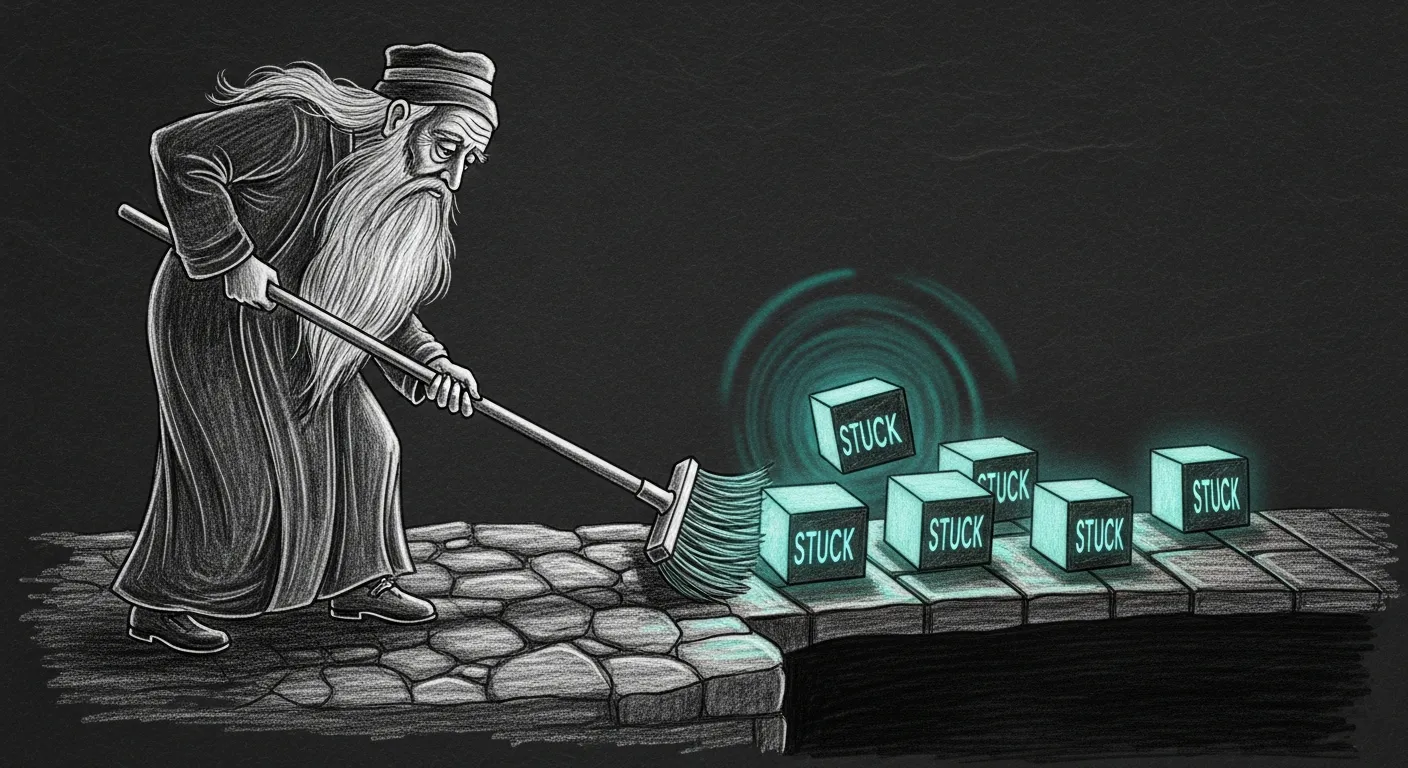
The first-floor Apple TV woke at 10:00 Sunday like every other morning — except it didn’t. Bell Fibe, dead. Everything else, dead. The kid reported it the way kids report an outage: loudly, and on a Monday. By then the thing had been silently grounded for over a day. The curfew had lifted. Something had not let go.
What had not let go was a pair of iptables rules.
What survived
Section titled “What survived”rule_484 and rule_485 were born on 2026-04-16 — over a month before
anyone missed them — during the early Apple TV blocking experiments.
Each was a bidirection device-wide MAC block: one rule dropped
outbound, one dropped inbound, paired by Firewalla policy ID. The
mechanism was blunt and correct — any packet whose destination matched
the device’s ipset got MARK-ed for drop.
For a month they sat dormant. Firewalla’s reconciler treated the parent
policy as stale, the kid wasn’t being blocked, and nobody looked. Then
Saturday night the weekend curfew fired at 23:30 and the bridge laid a
fresh round of blocks across the Apple TVs. Sunday at 10:00 the wake
tried to lift them. The bridge’s _unblock_mac API call returned
undefined (Firewalla MSP delete is degraded), so it dropped to its SSH
path:
[ssh-fallback] batch cleanup: 1/2 iptables rules removed for PIDs [485]One of two. The bridge then wrote:
[unpause] SSH iptables screen_time rules cleaned for FA:CE:DE:CA:CA:11Claimed success. Returned success: true for the PID. Moved on.
The inbound-direction rule stayed. Inbound video packets had nowhere to go, and Bell Fibe — like nearly everything else worth watching — arrives over an inbound TCP connection. The TV could reach out. Nothing could reach back.
This is the exact failure Principle 8 was written to name: a system that lies about its health is more dangerous than one that fails. The “1/2 cleaned” was right there in the log. But the per-PID contract said “succeeded,” and everyone downstream — the haus-control enforcer, the operator’s mental model, the SwiftBar glyph — trusted the contract over the log.
What’s now in place
Section titled “What’s now in place”Windu holds the security seat on the council, and this is a security failure in the plainest sense: a block that outlived its authority. Two changes, layered.
Layer 1 — the bridge stops lying
Section titled “Layer 1 — the bridge stops lying”sshCleanupIptablesRules in ~/.openclaw/firewalla-bridge.js now runs a
read-back grep in the same SSH session that issued the -D commands.
After the while read rule; do sudo iptables $rule; done loop completes,
the same session asks sudo iptables -S | grep 'rule_<pid>' || true and
the script parses the residuals. Any PID whose rule survived the delete
is reported with success: false and the log line escalates from INFO
to ERROR:
[ssh-fallback] batch cleanup PARTIAL: cleaned 1/2 rules, 1 RESIDUALfor PIDs [485] — drift-sentinel will sweep within 5minHonest signal in, honest signal out. A partial cleanup now looks like a partial cleanup instead of a complete one, and the consumer downstream gets to decide what that means.
Layer 2 — Windu sweeps every five minutes
Section titled “Layer 2 — Windu sweeps every five minutes”check_stale_blocks is a new check in Windu’s drift-sentinel — the
com.sanctum.drift-sentinel LaunchAgent that already runs every 5 min on
the Mini. Every cycle, it:
- Asks Firewalla over SSH for
iptables -S FW_FIREWALL_DEV_BLOCK - Extracts every
rule_<PID>token in the chain - For each PID, asks Firewalla’s redis:
EXISTS policy:<PID> - Any PID whose
EXISTSreturns 0 is an orphan — an iptables rule with no enforceable source policy - Deletes each orphan via
iptables -Dusing the rule spec, plus any redispolicy:<PID>remnant - Capped at 10 deletes per run — anything more escalates to Force
Flow
/notify(severity=warning) instead of bulk-deleting (a panic would look exactly like a runaway clean)
Each individual delete logs stale_block_healed; the run’s aggregate
logs stale_blocks_healed with {healed, orphan_pids, stuck}. The
drift-sentinel’s existing 30-min alert cooldown still applies on top.
Windu has never caught a mouse — Tommy keeps that ledger, and he brings it up — but Windu will now catch a stuck block inside five minutes. Had this check existed yesterday, recovery would have been five minutes instead of twenty-eight hours.
What this leaves
Section titled “What this leaves”The two stuck rules were cleaned by hand at 12:30 Monday — iptables -D
plus redis-cli DEL policy:484 policy:485. Drift-sentinel ran
immediately after and reported stale_blocks_clean { pids_checked: 48 }:
48 active block PIDs verified, 0 orphans. Tonight at 23:30 the curfew
fires again; tomorrow at 10:00 the wake will unpause; and any rule that
doesn’t leave through the front door gets swept by Windu inside the same
five minutes the operator spends brushing their teeth.
The bridge’s other SSH-fallback paths — single-PID cleanup, DNS custom-conf edits — still claim success without verifying. They haven’t produced this class of failure yet. But Principle 8 has taught the haus that “yet” is the most expensive word in the log, and those paths get the read-back the next time we open them.
Field note from the operator’s seat. The cleanup that was half-done is now done, and the daemon that pretended to know is now the daemon that actually checks.