

2026-06-20: The Post-Quantum Vault Ceremony
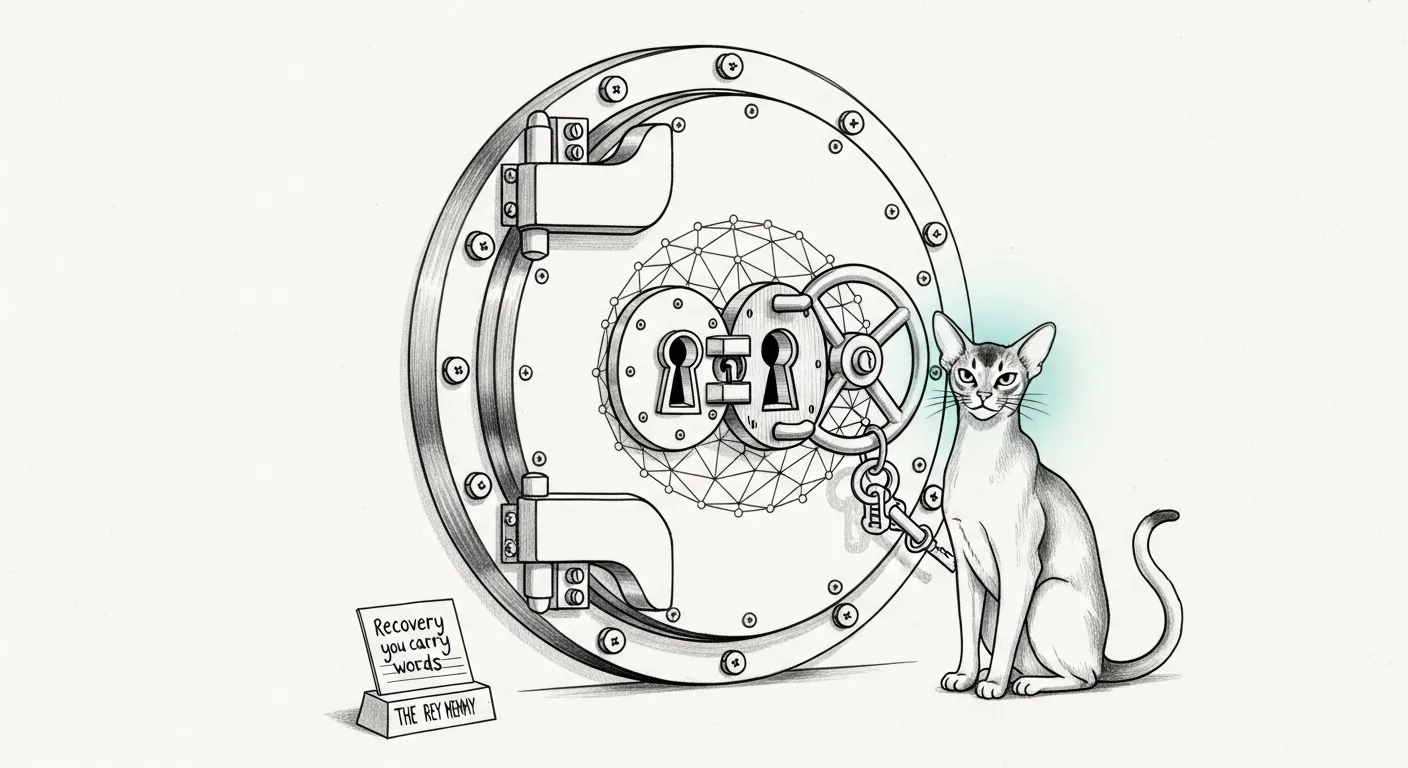
A patient adversary does not need to break your encryption. He needs to copy it, and wait.
Most of the stack defends data in motion — mTLS on :1337, post-quantum key
exchange at the proxy, WireGuard between machines. That
is the wire, and the wire is the easy part. The hard part is the archive.
Some data stays sensitive forever, and forever is long enough for that patient
adversary to harvest the ciphertext today and read it the morning a quantum
computer finally boots. Harvest-now, decrypt-later. A faster classical cipher
does not save you here. Only a vault whose confidentiality does not rest on a
problem a quantum computer makes easy.
sanctum-vault is that vault. Quantum-resistant at-rest encryption, plus a
recovery ceremony deliberate enough to trust with data you can afford neither to
lose nor to leak.
The cipher — hybrid, never weaker than the classic
Section titled “The cipher — hybrid, never weaker than the classic”The seal wraps a data-encryption key with the X-Wing KEM combiner
(draft-connolly-cfrg-xwing-kem): X25519 (classical) and ML-KEM-768
(post-quantum, FIPS 203), combined so the result is at least as strong as the
stronger half. The payload itself is sealed under a committing AES-256-GCM
AEAD, framed in 1 MiB chunks, with a separately signed manifest carrying the
algorithm identifiers and the recipient fingerprint. Belt and suspenders — and
the suspenders came back from the future to warn us.
The ceremony — mint, anchor, drill, seal
Section titled “The ceremony — mint, anchor, drill, seal”Encryption is the easy 10%. The 90% that earns trust is custody and recovery — the part nobody watches until the night it is the only thing that matters.
- Mint, air-gapped.
mint-recipientruns undersudo unshare -n— a network namespace with no interface but loopback — so the secret key has no exfiltration path at the instant it is born. The key lands root-owned, mode0600. - Anchor on paper.
init-recoverywraps the secret key under an Argon2id (RFC 9106) key derived from a handful of diceware words. The words are shown once, on your screen, and are never stored or logged. A passphrase KDF has no public-key surface for a quantum computer to attack, so the paper anchor is quantum-safe by construction — and memorable enough to carry without a sheet. - Drill — the hard gate. Recover the key from the container using only the words, and prove the recovered bytes are identical to the original. Nothing downstream is trusted until this is green. This is the gate that earns the right to seal.
- Seal. Public-key only — no secret needed to encrypt. The output is a
write-once
.svaultplus a signed manifest. On a macOS cold store the artifact is also made immutable (chflags uchg). - Verify.
verify --manifest --pin <signer-vk>cross-checks the signature, the pinned signer, and KEM-algorithm consistency in one gate.
What “verified” actually means
Section titled “What “verified” actually means”The seal was put through an end-to-end sweep. Real artifacts crossed real boundaries. Not “the field exists” — the bytes match.
| Property | How it was proven |
|---|---|
| Ciphertext integrity, machine-to-machine | one sha256 identical on the working host and the vault host — not “the field exists,” the bytes match |
| Immutability | enforced, not asserted — an mtime-only touch is denied (Operation not permitted), sha256 unchanged after |
| Recovery | the paper words reproduce the secret key byte-for-byte; until that is green, no seal is trusted |
| Manifest signature | verified against the pinned signer, with a wrong-pin negative control that rejects |
| Key custody | the secret key is root-owned 0600; the unprivileged service user genuinely cannot read it; the integrity gate runs as root |
Three boundary gotchas
Section titled “Three boundary gotchas”This is the Contracts at the Boundary doctrine in miniature. Every one of these was a bug caught before it shipped, because the test was written from the consumer’s reality instead of the producer’s hope.
- Exit codes lie across
limactl shell. Run a guest command through it and even-- falsereturns0— the outer exit code carries no information. Every cross-boundary decision in the tooling gates on an explicit STDOUT sentinel (__MATCH__/__DIFFER__/__UNREADABLE__), and “no verdict at all” is a loud failure, never a silent pass. An exit-code gate here would have printed “recovery proven” on a recovery that never happened. - A backstop blob is not a recovery container. The low-level
escrowprimitive emits a bare blob that the recovery path cannot read (it lacks the wrapped-key nonce). The recoverable artifact comes frominit-recovery. Same friendly intent, deliberately different call — and the difference is whether your words can ever open the vault. - The mint runs as root; the tooling does not. Because the key is born
root-owned
0600, every key-touching operation runs undersudo -nin-guest. The privilege that created the key is the only one that may read it.
Honest edges
Section titled “Honest edges”Two things the sweep found and did not paper over. A security page that only lists wins is a marketing page.
The diceware words never touch a disk. They live in exactly one place: your head. So does the vault.
The doctrine, in one line: encrypt for the adversary you’ll face in thirty years, recover from something you can carry in your head, and trust no gate you haven’t watched reject.