

2026-04-24: Sunday Sync — airgapped tarball push and the Monday morning canary
The council broke at 2 AM, and the error made no sense: Unknown agent id "yoda". Yoda is the orchestrator — the one agent that is always supposed to be there. Getting told he does not exist is like a courtroom convening to discover it has no judge.
The cause was not Yoda. The haus keeps three copies of openclaw across two machines: the Mac Mini runs the orchestrator and CLI, the OpenClaw VM runs the gateway and council agents, and a third copy — the npm-global CLI shim on the VM — sat a version behind both. Two minor versions of drift between caller and callee silently eats agent config fields; the newer CLI wrote config the older one dropped as stale, including the field that named the agents. So the council forgot its own chairman.
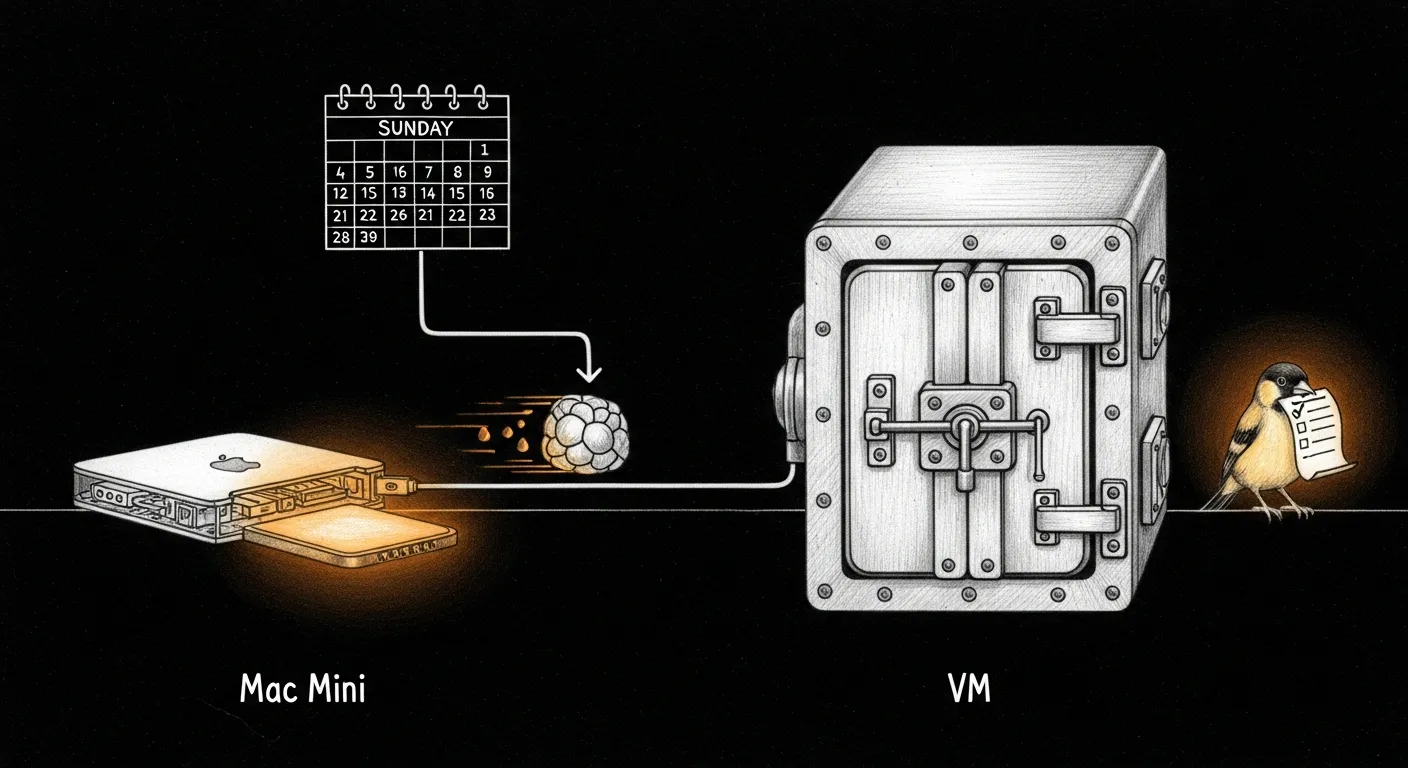
By morning all three report OpenClaw 2026.4.22, a Sunday LaunchAgent keeps them that way, and a Monday LaunchAgent checks that the Sunday one worked. The whole thing respects the VM airgap — intentional, briefly mistaken for a NAT bug.
The Starting Drift
Section titled “The Starting Drift”Before the work: three openclaw installs across two machines, three different versions.
| Surface | Install path | Version |
|---|---|---|
| Mini CLI | /opt/homebrew/lib/node_modules/openclaw (npm-global) | 2026.4.14 |
| VM CLI | /home/ubuntu/.npm-global/bin/openclaw (npm-global) | 2026.4.11 |
| VM gateway | /home/ubuntu/.openclaw/node_modules/openclaw (pnpm-local) | 2026.4.14 |
The VM CLI was writing config with fields the 2026.4.11 CLI couldn’t parse. Stale config warnings flooded the logs. council-session.sh invocations that went through the npm-global CLI would see a config that referenced agents the binary didn’t understand, drop those fields as stale, then fail with Unknown agent id "yoda" — a bug that presented as “the council is broken” for most of the night before the version split was diagnosed.
The goal: get all three surfaces on the same version. Pick pnpm. Keep them that way.
What Broke My Mental Model
Section titled “What Broke My Mental Model”Three moments tonight where my first instinct was wrong:
1. The VM isn’t broken, the VM is sealed
Section titled “1. The VM isn’t broken, the VM is sealed”First try at upgrading the VM CLI: pnpm add -g [email protected] errored EAI_AGAIN: getaddrinfo registry.npmjs.org. Diagnosed the NAT — ping Mini-bridge works, ping 1.1.1.1 100% loss. Was about to escalate “VM has lost internet.”
Correction from Bert: “The VM has no internet on purpose, that’s why we use vm-push.” The VM is airgapped by design. vm-push.sh is the established pattern for pushing data out (VM git state → GitHub via Mac bundle). No symmetric pattern for pulling npm packages in — that was tonight’s work.
2. The council can’t advise on how to build itself
Section titled “2. The council can’t advise on how to build itself”Second instinct: convene the council on the delivery architecture — three options, a real A/B/C. Yoda, Quigon, Windu returned [No response]. Synthesis failed. Two issues compounded:
- LLM backend was down post-reboot.
sanctum-mlxon:1337listening but not serving — the same listening-but-silent failure the reasoner threw on April 19th — and the LM Studio fallback referencedqwen/qwen3.5-35b-a3b, retired 2026-04-22. Both paths dead. council-session.shhung on Yoda. Script invokedsend.sh yoda yoda session high <prompt>— Yoda processing a message addressed to itself. 27 minutes of thinking before I killed it.
Fixed in openclaw-skills a764146: Yoda is always orchestrator and synthesizer, never a participant — the script now filters yoda out with a NOTE when callers include it out of habit. It is the same chairman-not-participant rule the Council Router enforces at the routing layer, arriving one script later at the session layer.
3. The VM can’t receive apt either
Section titled “3. The VM can’t receive apt either”The Sunday script originally had an apt-upgrade branch. apt install unattended-upgrades hung resolving ports.ubuntu.com. Same airgap. The script now reports VM: apt is intentionally airgapped — skipping upgrade. A future apt-mirror on the Mini would change this, but it’s not tonight’s work.
The Tarball Push
Section titled “The Tarball Push”The delivery pattern that does work — and mirrors the shape of the existing vm-push for git state — is:
-
Stage on Mini. A throwaway
/tmp/oc-stage-<target>/with a one-linepackage.jsonpinning openclaw to the target version, thenpnpm install --config.node-linker=hoisted --config.ignore-scripts=true. Hoisted linker produces a flatnode_modules/with no symlinks into the pnpm store — self-contained and portable. -
Tar + gzip. 404 MB flat → ~101 MB compressed. Transferred to VM in ~1.1s over the bridge.
-
Atomic swap on VM. Stop the gateway.
mv node_modules node_modules.bak-$(date +%Y%m%d-%H%M%S). Extract the newnode_modulesinto~/.openclaw/. Updatepackage.json’s openclaw pin. UpdateOPENCLAW_SERVICE_VERSION=in both systemd unit files. Repoint the/home/ubuntu/.npm-global/bin/openclawsymlink at the new pnpm-local binary so tools hard-coding the npm-global path (council-router among them) transparently upgrade. Daemon-reload, restart, verifyis-active. -
Prune. Keep the last 2
node_modules.bak-*directories; delete older ones. Clean up the staging dir and the tarball on both ends.
The script that does all of this lives at ~/.sanctum/bin/sanctum-sunday-upgrade.sh on the Mini and is tracked in Ogilthorp3/sanctum-config. It handles the Mini CLI upgrade via pnpm add -g openclaw@$target, then fires the tarball push for the VM, then runs brew update && brew upgrade on the Mini, then reports apt status on the VM without trying to upgrade.
The Tripwires
Section titled “The Tripwires”Openclaw publishes roughly every 24–48 hours. “Stable” here means the latest dist-tag (no separate stable channel exists). Auto-upgrading to something published hours ago is a recipe for shipping regressions into production on a Tuesday morning.
Three gates must all clear before the openclaw step runs. If any fire, the openclaw upgrade skips; brew still runs.
| Tripwire | What it checks | Why |
|---|---|---|
| Age ≥ 48 h | npm view openclaw time --json | Community shake-out window. If it’s been less than two days, defer. |
| No blocking issues | gh issue list openclaw/openclaw --search "$version" filtered for crash|regression|broken|revert|cannot start|boot loop|unusable | Someone might have filed a show-stopper against this exact version. |
| Not deprecated | npm view openclaw@$version deprecated | npm marks versions deprecated when they’re actively being pulled. |
First real Sunday fires 2026-04-26 at 09:30 local. 2026.4.22 will be ~75 hours old by then (published 2026-04-23T14:21Z). Clears the age tripwire.
The Monday Canary
Section titled “The Monday Canary”com.sanctum.sunday-upgrade-check fires every Monday at 10:00. It reads yesterday’s upgrade log (~/.sanctum/upgrade-logs/<yesterday>.log), filters the known-good WARN lines (the airgap-skip, the three tripwire skips for age/deprecation/open-issues), parses the Final state block, and verifies that Mini CLI, VM CLI, and VM gateway all report the same version. If anything is off, it fires a Signal alert via send.sh jocasta yoda alert high — fire-and-forget, detached with nohup + disown so the check itself never blocks on an LLM call.
Silent on success. Loud on any drift between the three surfaces or on any WARN line the filter doesn’t recognize. Check script itself runs in 0.15 s — the alert’s LLM inference happens downstream on its own timeline.
Commit Trail
Section titled “Commit Trail”| Repo | Commit | What |
|---|---|---|
sanctum-config | d066342 | Sunday orchestrator + launchd template |
haus | a53e1ec | VM gateway bumped to 2026.4.22 via tarball push |
sanctum-config | 7261787 | Narrow the apt sudo probe to match the NOPASSWD grant |
sanctum-config | 59a7587 | Drop the apt-upgrade attempt — honor the airgap |
sanctum-config | fc0db9b | Monday canary — sunday-upgrade-check.sh + plist |
openclaw-skills | a764146 | council-router: skip Yoda as participant, fix self-addressed hang |
What This Changes Going Forward
Section titled “What This Changes Going Forward”- Weekly cadence. Openclaw stays within one upgrade window of
latestwithout manualpnpm add -g. If upstream ships a regression, tripwires catch it; if tripwires let a bad one through, the Monday canary catches drift between the three surfaces. - The airgap is honored by default now. No script in the haus tries to reach public package mirrors from the VM. If a future workload needs that, it adds an explicit push channel, it doesn’t open NAT.
- The council can be convened again. The self-addressed-hang is fixed, so future sessions on architectural A/B/C questions won’t silently die on the first participant when Yoda appears in the participants list out of habit.
- One new LaunchAgent pair joins the family.
com.sanctum.sunday-upgradeandcom.sanctum.sunday-upgrade-check. Both bootstrapped persistently vialaunchctl bootstrap gui/$(id -u), both logging into~/.sanctum/upgrade-logs/, both silent on success and loud only on anomaly. Not a new pattern — just another entry in the same book.
None of this is glamorous. It is a tarball, a symlink, and two launchd jobs that mostly do nothing. But drift is the failure that only surfaces at 2 AM, addressed to the one agent who is supposed to always answer — and the entire point of a weekly heartbeat is that nobody has to be awake to read the log where it quietly didn’t happen.